
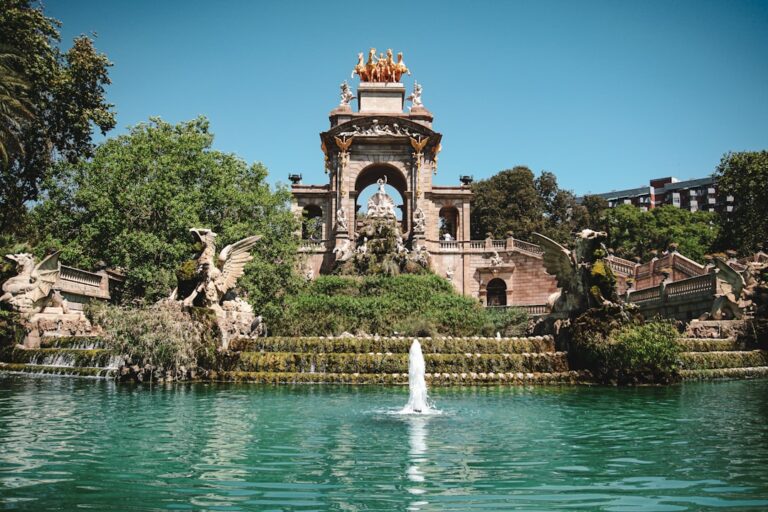
Every Sunday, families picnic on the grass of Parc de la Ciutadella. Couples row boats across the ornamental lake. Tourists photograph Gaudí’s early fountain. Nobody talks about what’s buried underneath.
Because the most beloved park in Barcelona was built on top of a neighborhood that was razed to the ground — and a military cemetery that held the bodies of soldiers who fought to conquer the city. The history of this place is as layered as the city itself. And once you know it, the park looks completely different.
The Fortress That Erased a Neighborhood
In 1714, after a brutal 14-month siege, Barcelona fell to the Bourbon forces of Philip V. The city had backed the losing side in the War of the Spanish Succession, and the new king was not feeling merciful.
His revenge was architectural. Philip V ordered the construction of a massive military citadel — the Ciutadella — in the eastern corner of the city. But to build it, he first had to demolish an entire neighborhood: the Ribera district, home to over 1,000 families. Roughly 4,500 people were forcibly displaced. Their homes, churches, and streets were simply erased. The construction began in 1715, and by 1718 a star-shaped fortress rose where a living neighborhood had stood.
The fortress also included a military cemetery — used for over a century to bury soldiers of the Spanish crown. The same soldiers who had besieged and defeated Barcelona.
For 150 years, the Ciutadella stood as a symbol of military occupation. Catalans never forgave it. When General Prim — himself of Catalan origin — finally ordered the demolition of the fortress in 1869, the city celebrated in the streets. The land was converted into a public park, inaugurated in time for the 1888 Universal Exhibition.
Today you can walk the park and feel those layers if you know where to look. The ornamental lake sits roughly where the main parade ground stood. The neoclassical buildings along the park’s edge — now home to the Catalan Parliament — were once military barracks. And the Museu de Ciències Naturals occupies one of the few surviving structures from the 1888 exhibition.
What the Park Hides — And What It Celebrates
The most famous object in the park is the monumental cascade fountain at its northern end. It’s spectacular — baroque, theatrical, almost Roman in scale. What most visitors don’t know is that a young architecture student named Antoni Gaudí assisted in its design. It was one of his very first projects, completed in 1882, years before the Sagrada Família would consume his life.
Stand in front of it and you’re looking at early Gaudí — exuberant, ornamental, slightly unhinged. Already recognizable, even in a crowd.
The park also contains the Barcelona Zoo, which opened in 1892 on the same grounds. For decades it was home to Snowflake, an albino gorilla who became the unofficial mascot of the city and lived here until his death in 2003. There’s a small statue near the zoo entrance. Locals still leave flowers.
If you’re spending your last morning in Barcelona here — which you absolutely should — this park is the perfect place to close the trip. Slow coffee at one of the café terraces along Passeig de Picasso, a final walk under the fig trees, a look at the Gaudí fountain. And if your bags are already sorted, all the better. Lybag picks up your luggage directly from your hotel and delivers it to the airport, Sants station or the cruise port — from just 9€ per bag — so your last hours in the city don’t involve dragging wheels over cobblestones.
Beyond the fountain, the park has a small but excellent Natural Science Museum — the Museu Blau’s original location — and the beautiful iron-and-glass Hivernacle greenhouse, which today hosts occasional jazz concerts and cultural events. Check the program before you go.
And if you look carefully at the northeastern corner of the park, near the old military governor’s building, you’ll find faint traces of the original fortress walls. Not marked, not explained. Just stone, still standing.
Barcelona has a habit of building its future directly on top of its past, without quite covering it all the way. The Ciutadella is proof. Come for the boats and the Sunday calm — but don’t forget what the grass is growing over.