
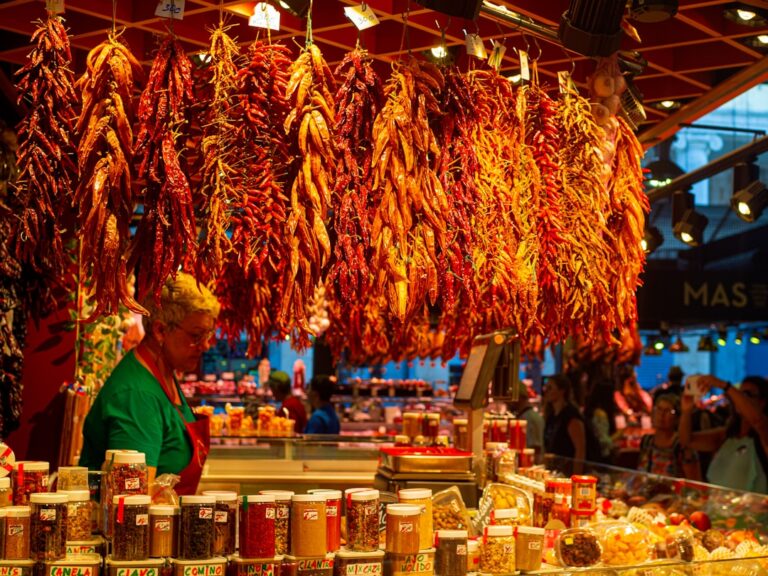
There’s a woman behind every market stall in Barcelona. There always has been. While historians wrote about generals and architects, the women of the Barceloneta fishermen’s quarter, the Raval tavern-keepers, and the vendors of the Boqueria were quietly feeding the city — and shaping it. Their history is mostly unwritten. But the places where they worked? Those are still very much alive.
The Fishwives of Barceloneta and the Birth of a Neighborhood
Barceloneta was built in 1753 — fast, cheap, and deliberately small. The Spanish military engineer Juan Martín Cermeño designed the grid of narrow streets and tiny apartments to house the fishermen and labourers displaced by the demolition of the Ribera quarter after 1714. Each apartment was just one room wide. One floor per family.
The women who lived there didn’t just run households in impossible conditions. They ran the local economy. The peixateres — the fishwives — controlled the sale of fresh fish from the beach, negotiating prices directly with the boats before the catch even touched the sand. They were not assistants to the fishermen. They were the commercial link between the sea and the city.
Walk down Carrer del Baluard today and you still feel the compressed energy of that original neighbourhood. The apartments are still narrow. The streets are still tight. And at La Cova Fumada on Carrer del Baluard 56 — no sign, cash only, closes before 3pm — the kitchen is still run by the granddaughters of that same Barceloneta tradition. This is where the bombeta was invented, the fried potato and meat ball that every tapas bar in Barcelona now sells. The original, though, tastes different. Because here, history is still cooking.
Before you leave Barceloneta for the next neighbourhood, this is exactly the kind of morning worth protecting. No luggage, no rushing. If you’re flying out later that day, Lybag picks up your bags from your hotel from 9€ and gets them to the airport while you’re still finishing your coffee — so the last hours in the city are actually yours.
The Market Women of La Boqueria and What They Were Really Selling
La Boqueria did not begin as a market. It began as a problem. For centuries, vendors — mostly women — sold food illegally along the old city walls near La Rambla. Meat, eggs, vegetables, bread. The authorities tried to move them, fine them, ignore them. Nothing worked. By 1840, the city gave up and built them a covered market instead.
The iron structure you see today was completed in 1914 — a cathedral of food built on top of a convent demolished during the liberal reforms of the 1830s. What the guidebooks don’t tell you is that the market’s social infrastructure was already female before the roof went up. The women who had been selling in the open air for generations simply moved inside and kept going.
The tourist crowd today makes it hard to see, but the real Boqueria still exists if you know where to look. Avoid the front stalls with the pre-cut fruit cups. Walk to the back left corner. That’s where the serious vendors are — the ones selling salt cod, dried legumes, artisan cheeses, fresh herbs by weight. Pinotxo Bar, just inside the main entrance to the right, has been run by the same family since 1940. Juanito Bayen, the face of the bar for decades, recently retired — but the bar carries on. The cigrons amb botifarra (chickpeas with sausage) at the counter, standing, at 8 in the morning, remains one of the great Barcelona experiences.
The women who built this market understood something important: food is never just food. It’s negotiation, community, memory. The Boqueria survived a civil war, a dictatorship, and forty years of mass tourism. That’s not luck. That’s infrastructure built by people who knew exactly what they were doing.
Barcelona’s real history is not in the monuments. It’s in the markets that are still open, the bars that never changed their menu, the neighbourhoods built for working people that somehow held on. The women behind those stalls didn’t leave diaries. They left recipes, buildings, and a city that still runs on what they made. That’s worth knowing before you visit — and worth remembering long after you leave.