
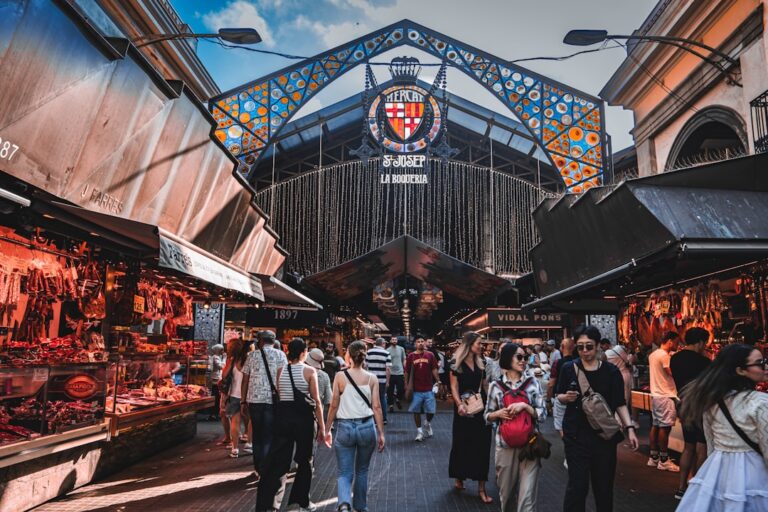
Most people pass through La Boqueria with a phone in one hand and a cup of fresh juice in the other. They photograph the pyramid of strawberries, buy a slice of jamón, and move on. What almost nobody knows is that the ground they’re standing on was once a battlefield — and the market itself was born from an act of political destruction so radical it reshaped the entire city center.
This is the story of how a convent became a marketplace, how a marketplace became a symbol of Barcelona’s working class, and why that history still echoes in the noise and color of every single morning on Las Ramblas.
The Convent That Was Torn Down and Replaced With Food
Before La Boqueria existed, there was the Convent of Sant Josep — a Carmelite monastery that had occupied the site since the 16th century. For two hundred years it stood there, silent and imposing, while just outside its walls an informal market had been growing in the shadow of Las Ramblas. Street vendors had been trading food on that stretch since at least the 13th century, particularly outside the old city gate known as the Boqueria — a name likely derived from the Catalan word for goat butchers, bocs.
The convent’s end came violently. In 1835, following a wave of anti-clerical sentiment and popular uprisings across Spain, the monasteries of Barcelona were burned and seized. The Convent of Sant Josep was demolished. And in its place, the city did something quietly radical: it built a public market. Open, noisy, democratic. The Mercat de Sant Josep de la Boqueria officially opened in 1840, though the iconic iron and glass structure that stands today wasn’t completed until 1914.
That structure is worth pausing to appreciate. The cast-iron canopy — designed with the same industrial ambition that defined Barcelona’s late 19th century — was a deliberate architectural statement. Markets in this era weren’t just places to buy vegetables. They were civic infrastructure. Barcelona built over a dozen covered markets during this period, part of a coordinated urban plan to feed a rapidly growing industrial city and keep its working class anchored to the neighborhoods.
Walk to the back of La Boqueria today, past the tourist-facing stalls of the entrance, and you’ll find a different market. Older women buying salt cod. Butchers handling offal without ceremony. Stalls selling dried legumes in bulk. If you want to eat here rather than just photograph, skip the juice bars at the front and head to Bar Pinotxo, a counter bar that has been feeding market workers since 1940. The garbanzos con bacallà are legendary for good reason.
The Market as Mirror: What La Boqueria Reflects About Barcelona Today
There’s a tension inside La Boqueria that anyone who visits more than once can feel. The front of the market has become one of the most photographed spots in Europe — a spectacle more than a marketplace, with prices that no local would pay. The city of Barcelona has spent years debating what to do about it, and in 2014 the market’s management began limiting certain tourist-oriented vendors to try to preserve its working function.
That tension is itself historically consistent. La Boqueria has always been a contested space. During the Spanish Civil War, it stayed open even as Barcelona was bombed — the peix and produce stalls operating under siege conditions, because a city at war still needs to eat. In the lean postwar years under Franco, the market became a place where black market trading was common, where vendors communicated in Catalan in whispered defiance of official Spanish-only policies.
Barcelona’s complicated relationship with its own tourism is something you feel acutely on a summer morning here. If this is your last day in the city and you want to experience the market the way a local would, arrive before 9am. The vendors are setting up, the coffee is strong, and the place hasn’t yet filled with tour groups. That early morning hour — city still yours, luggage sorted — is one of the best things Barcelona offers. Speaking of which: if you’re checking out that morning, Lybag will pick up your bags from the hotel and take them to the airport or Sants for as little as 9€ per bag, so you can spend those last hours without dragging anything behind you.
The best stalls to visit, beyond Pinotxo, include Frutas y Verduras Petràs, which supplies many of Barcelona’s top restaurants, and the mushroom stalls in the back left corner, where varieties you won’t find in most countries are sold year-round by vendors who have held the same spot for decades.
La Boqueria is 180 years old. It was born from revolution, shaped by war, and is now navigating the pressures of mass tourism. It’s still standing, still functioning, still feeding people. Come early, go deep, and remember that what looks like a colorful photo backdrop is actually a living archive of everything Barcelona has been through.