
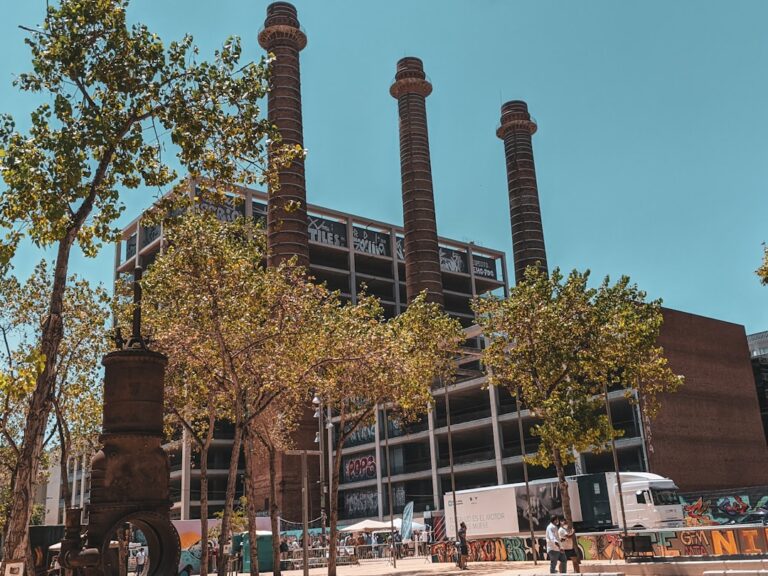
There’s a neighborhood in Barcelona where you can eat breakfast inside a century-old textile factory, visit a contemporary art gallery in a former bleaching plant, and finish the night dancing in a converted warehouse. This is Poblenou — and most tourists never make it here.
They’re missing the most honest story Barcelona has to tell: how a city rebuilds itself without erasing its past. While the Gothic Quarter sells medieval romance and the Eixample flaunts Modernista facades, Poblenou holds something rarer. The memory of work. Of smoke. Of a working class that made Barcelona rich and got very little in return.
Understanding this neighborhood changes how you see the whole city.
The Manchester of Catalonia — and What Happened Next
In the 19th century, Poblenou was the industrial engine of southern Europe. By 1850, the area packed more steam-powered factories per square kilometer than almost anywhere on the continent. Locals called it the Manchester of Catalonia. Cotton mills, chemical plants, gas works, metalworks — they all ran along the coast between the city center and what is now the Forum.
The workers who lived here weren’t Barcelonins by birth. They came from Murcia, Almería, Aragón — migrants drawn by factory wages. They built their own culture: ateneus obrers (workers’ cultural centers), cooperative bakeries, anarchist libraries. The neighborhood had its own internal world, largely invisible to the bourgeoisie up in the Eixample.
Then came deindustrialization. From the 1970s onward, one by one, the factories closed. Poblenou fell into a strange limbo — too far from the center to gentrify quickly, too scarred by industry to attract casual visitors. Entire blocks sat empty for decades.
The 1992 Olympics changed the coastline forever, reclaiming the beach and building the Vila Olímpica just south of Poblenou. But the neighborhood’s real transformation came later, with the 22@ urban plan launched in 2000, which rebranded the area as a technology and innovation district. Old factories were either demolished for office towers or — crucially — preserved and repurposed.
Walking along Carrer Pallars or Rambla del Poblenou today, you move between those two outcomes constantly. A sleek coworking space next to a crumbling chimney. A rooftop bar above a nave industrial still wearing its original ironwork.
Where the Past Is Still Alive — and Where to Go Today
The best surviving example of Poblenou’s industrial heritage is Palo Alto Market, held in the gardens of a 19th-century factory complex on Carrer dels Pellaires. The original brick buildings are intact, the old chimneys still stand, and on market weekends the whole space fills with independent designers, food stalls and live music. It’s one of the most atmospheric markets in Barcelona — and almost no one outside the city knows it exists.
For a deeper dive into the industrial memory of the neighborhood, the Museu d’Història de Catalunya holds permanent exhibitions on Catalan industrialization, though for something more immersive, a walk through the heritage route marked on the Poblenou Urban District map reveals over 40 protected industrial buildings still standing in the area.