
There’s a street in Poblenou where a textile factory chimney still stands next to a craft beer bar. Nobody tore it down. Nobody moved it. It just became part of the furniture — a monument to the neighborhood’s stubborn refusal to forget where it came from.
Poblenou is Barcelona’s most honest neighborhood. It doesn’t pretend to be something it’s not. The bones of the old industrial city are still visible everywhere: in the exposed brick, in the wide streets designed for carts and trucks, in the factory gates that now open onto design studios and co-working spaces. If you’ve only seen the Gothic Quarter and the Eixample, you’re missing half the story of this city.
The Manchester of Catalonia: A District Built on Steam
In the mid-19th century, Poblenou was called the Manchester of Catalonia — and not as a compliment. The industrial revolution hit Barcelona hard and fast, and Poblenou took most of the impact. By 1850, the neighborhood was packed with textile mills, chemical plants, and iron foundries, all powered by steam engines and the labor of thousands of workers who had migrated from rural Catalonia and the rest of Spain.
The conditions were brutal. Workers lived in cramped housing directly adjacent to the factories — some buildings served both purposes simultaneously, with workshops on the ground floor and sleeping quarters above. The neighborhood had one of the highest rates of industrial accidents in Europe. It was also one of the most politically radicalized: Poblenou was a hotbed of anarchism, socialism, and the early Catalan labor movement. The famous Ateneu Enciclopèdic Popular, founded in 1903, was part of this wave of worker education and political organization.
The decline came slowly, across the second half of the 20th century. Factories closed, workers left, and Poblenou fell into a long, strange silence. But the bones remained. The chimneys, the warehouses, the iron gates with Art Nouveau lettering — all frozen in place, waiting for someone to decide what they were worth.
The answer came in 2000, with the launch of the 22@ innovation district, one of the most ambitious urban transformation projects in European history. The city rezoned 200 hectares of industrial land for technology companies, creative industries, and universities — while requiring that a significant portion of the old industrial heritage be preserved. It was a rare moment of urban intelligence: growth without erasure.
Today you can walk Rambla del Poblenou and still see the traces of that industrial past in the architecture — the wide facades, the heavy doors, the occasional chimney rising above a startup office. If you’re spending your last morning in Barcelona wandering these streets before catching a flight, let Lybag handle your luggage — they’ll pick it up from your hotel from just 9€ and deliver it to the airport while you keep walking without the weight on your shoulders.
What Poblenou Looks Like Today — and Where to Go
The transformation of Poblenou is visible in layers. Walk down Carrer Pallars and you’ll pass a 19th-century warehouse that now hosts Palo Alto Market, one of Barcelona’s best design markets, held the first weekend of every month. The building still has its original iron structure. The aesthetic is entirely deliberate: the market curates designers and independent creators who work in precisely the kind of reclaimed industrial space that surrounds them.
For coffee and context, Cafè Federal on Carrer del Parlament isn’t in Poblenou but the spirit has spread — look instead for Nomad Coffee Lab on Carrer Bac de Roda, one of the most respected specialty coffee roasters in Spain, operating out of a space that feels like it could have stored machinery fifty years ago. The exposed pipes and concrete walls aren’t a design choice — they’re original.
Food-wise, Poblenou rewards exploration. El 58 on Rambla del Poblenou is a Barcelona classic — honest Catalan cooking, good wine, no fuss. For something newer, the area around Carrer dels Almogàvers has seen a wave of small restaurants and wine bars opening in old commercial spaces, with a crowd that’s mostly local and entirely unselfconscious about it.
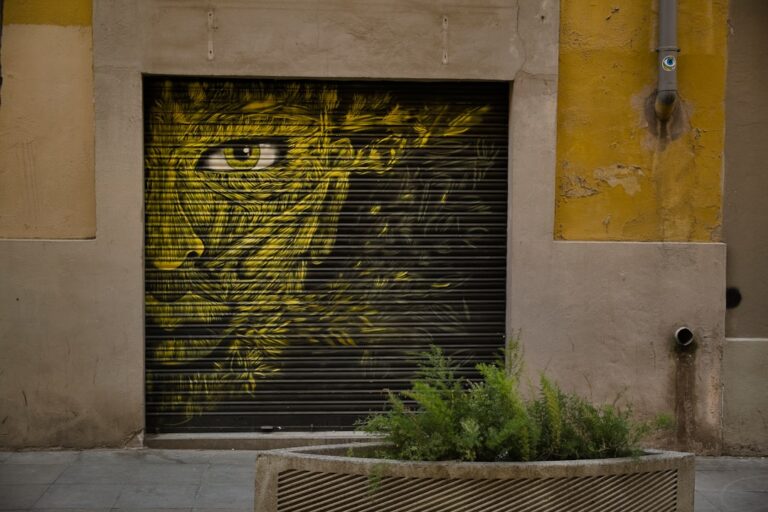
The street art is worth a separate afternoon. The Palo Alto area and the streets around Carrer LLULL have become an open-air gallery of murals and interventions, many of them commissioned by the city as part of the 22@ transformation. Unlike the street art in the Raval, which can feel performative, the pieces here tend to engage directly with the industrial history of the spaces they occupy — machinery, labor, migration, transformation.
Don’t miss the Can Framis Museum, a 16th-century farmhouse that somehow survived everything the industrial revolution threw at Poblenou and now houses a remarkable collection of Catalan painting from the 18th century onward. It’s one of the most undervisited museums in Barcelona, which means you’ll almost certainly have it to yourself.
Poblenou is the Barcelona that tourists rarely see and locals never left. Walk slowly. Look up at the chimneys. Order a beer at a table where someone used to operate a loom. The city is all there, layered into the bricks.